
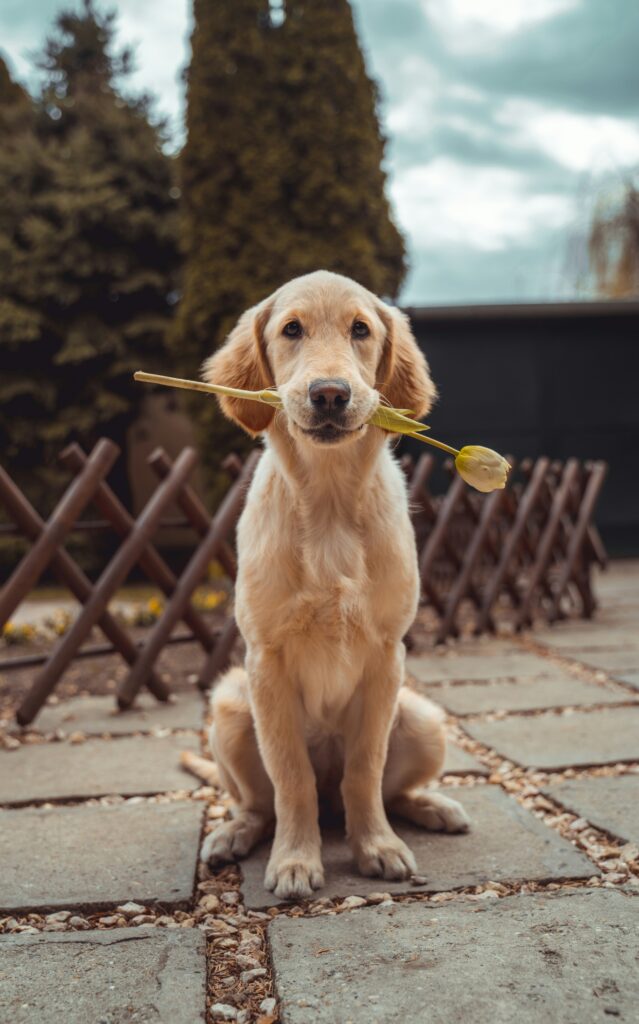
Dog Photography
How to Take Better Photos of Your Dog
Five tips the pros actually agree on - plus the real reason your dog looks away the second you lift your phone.
From the team at Squeak N Snap
You know the routine. Your dog is doing something heart-meltingly perfect - ears up, head cocked, that look - and you slowly reach for your phone. By the time the camera app opens, they have wandered off, sat down, or turned to stare at a leaf. You take the shot anyway. You take eleven more. None of them are the one you saw a second ago.
Squeak N Snap started with a Christmas card. Good friends of ours have three rescue huskies - stunning dogs, the kind that look like they belong on a calendar - and every year their holiday photo had the exact same problem. Three gorgeous huskies. Not one of them looking at the camera. The dogs looked great. They just would not look. We were sure there had to be a better way to win that half-second of attention, and the whole idea grew out of that one frustrating, very photogenic card.
So we did what any slightly obsessed dog people would do: we read everything. Working pet photographers, smartphone shooters, animal-behavior researchers. The advice turned out to be remarkably consistent, and it comes down to a handful of small changes that separate the photos you scroll past from the ones you actually print.
Here are the five that matter most. Four of them cost you nothing but a little patience. The fifth (we put it at number two, because it solves the hardest part) is the one we ended up building a product around.
The one every pro mentions first
Get down on their level
If you change one thing today, change this. Almost every photographer we read named it as their top tip, and it is the fastest upgrade you will ever make to a dog photo. Most of us shoot our dogs from a standing position, pointing the phone down at the floor. The result is the same flat, looming view we see all day long. It is fine. It is also forgettable.
Kneel. Sit. Lie flat on your belly in the grass if you have to. When your lens drops to your dog's eye level or just below it, three things happen at once. You see the world the way they live in it. The background falls away behind them instead of being a stretch of floor. And, just as importantly, you stop looking like a giant leaning over them, which makes a lot of dogs relax instantly.
A low angle does not just change the composition. It changes how your dog feels about the whole thing.
Got a small dog and creaky knees? Use the trick the pros use: ask your dog to "hop it up" onto a low wall, a tree stump, a couch, or a chair, and suddenly you are at eye level without folding yourself onto the ground. For very large dogs, the opposite can be lovely - sitting just below them and letting them look down slightly into the lens gives a warm, soulful portrait. Experiment with a few heights before you settle. The difference between a 5-foot angle and a 1-foot angle is night and day.
The hard part, and the fix
Catch the half-second they actually look at you
Now you are down at their level. Here comes the genuinely difficult bit, the one that fills up everybody's camera roll with rejects: getting your dog to point those eyes at the lens, and getting the shot while they are doing it.
There is real science under this. When a dog hears a new, interesting sound, their head snaps toward it before they have even decided to move. Behaviorists call it the orienting reflex - Pavlov nicknamed it the "what is it?" reflex. It is involuntary, it is why a squeak or a kissy noise produces that irresistible ears-up head-tilt, and it is the single most reliable way to earn a half-second of eye contact. Every photographer we read keeps a pocket full of squeakers and silly noises for exactly this reason.
But here is what nobody tells you, and it is the whole problem in a nutshell: the look lasts a heartbeat.
With an ordinary squeaky toy the sequence goes like this. You squeak, your dog looks, and then you scramble your thumb over to the shutter button - and by the time it fires, the ears have dropped and the moment is gone. You were a half-second late. You are always a half-second late.
Why the timing is the real enemy
A regular squeaky toy you miss the peak
The Joy Capture Kit squeak and shutter together
Same reflex, same dog. The only difference is whether the camera goes off during the look or just after it.
What we built
The Joy Capture Kit closes the gap
This is the exact problem we set out to solve. The Joy Capture Kit is a soft, squeezable plush that connects to your phone over Bluetooth. When you squeeze it, it squeaks and fires your phone's camera at the same instant. The squeak triggers the orienting reflex, and the shutter goes off right on the peak of it, while the ears are still up and the eyes are still on you. No fumbling for the button. No half-second too late.
We want to be straight with you, because that matters more to us than a sale: it is a tool, not a magic wand. You still need the other four tips on this list. You still need decent light, a sharp focus, and a little patience. What the kit does is take the one variable that is almost impossible to nail by hand - timing - and lock it down for you. That is the whole job.
See how it worksThe thing that quietly ruins most shots
Chase soft light, and turn the flash off
Light is the part beginners skip and pros obsess over. The good news is you do not need any equipment to get it right, just a sense of timing and where to stand.
The kindest light of the day is the golden hour, the hour or so after sunrise and before sunset, when the sun is low and warm and everything glows. Overcast days are secretly fantastic too: clouds turn the whole sky into one giant soft light that erases harsh shadows and squinting. Indoors, park your dog near a big window and let that soft daylight do the work. Avoid harsh midday sun directly overhead, which carves dark shadows under the eyes and makes most dogs squint.
Want the photo that stops the scroll? Put the sun behind your dog. Backlight rims their fur with a halo of light and, on longer-haired dogs especially, looks genuinely magical. You will need to tap your screen to brighten the exposure so their face does not go dark, but it is worth the fiddling.
If there is a single thing separating a snapshot from a portrait, it is the quality of the light falling on it.
And please, turn off your flash. A sudden pop of light startles a lot of dogs, throws off their reflex, flattens the photo, and tends to leave them with eerie reflective eyes. Natural light wins almost every time.
The detail that makes it feel alive
Lock the focus on the eyes
There is an old saying photographers repeat about every kind of portrait: the eyes are the window to the soul. It is true for dogs too. When the eyes are tack-sharp, a photo feels alive and you connect with it. When they are even slightly soft, the whole image feels off, even if you cannot say why.
On a phone, this is easy and most people never do it. Before you shoot, tap the screen right on your dog's nearest eye. That tells the camera to focus exactly there instead of guessing, and it usually locks your exposure to the right spot at the same time. On a proper camera, switch to single-point autofocus and place that point on the eye closest to you.
If you are using your phone's Portrait mode for that creamy blurred background, just glance at the result before you move on. It is lovely when it works, but it sometimes blurs the snout or an ear by mistake. A quick check saves you from a portrait that looks great until you zoom in.
Where the keepers really come from
Use bursts for action, then let them be themselves
Dogs do not hold still, and for some shots that is the whole point. When your dog is moving - the zoomies, the catch, the shake after a swim - firing a burst is the only way to freeze the action without blur. On nearly every phone you just hold down the shutter button (or slide it sideways) to rip off a rapid sequence, then scroll back and pick the sharpest frame. This is where burst mode earns its keep: motion, not eye contact. You have already handled the looking-right-at-you portrait back in tip two, so save the spray-and-pray for the moments that are genuinely too fast to time by hand.
Then, when the action settles, put the pressure down and just watch them. The yawn. The mid-shake blur. The goofy tongue. The way they flop onto your feet. Some of the most loved dog photos in the world are not posed at all - they are candid, a little imperfect, and unmistakably that dog. Those are the ones that make you laugh out loud in five years.
Above all: be patient, and keep it fun. Your dog reads your mood instantly. If you are relaxed and the whole thing feels like a game with good treats, you will get relaxed, happy photos. If you are frustrated, they will be too, and it shows in every frame.
The five-second version
- Get on their level. Drop the lens to their eyes or below.
- Catch the half-second. A squeak earns the look; the Joy Capture Kit catches it in time.
- Soft light, no flash. Golden hour, overcast skies, or a window.
- Focus on the eyes. Tap the screen right on the near eye.
- Bursts for action, candid for character. Save spray-and-pray for movement, and let them be themselves.
None of this requires a fancy camera or a photography course. It just requires knowing where to point, when to press, and how to earn that fleeting half-second of attention. Now grab your dog, get down in the grass, and go make something worth printing.
Free download
Get the complete Squeak N Snap Guide to Better Dog Photos
We turned everything we learned into one printable guide - the five tips above plus our full shot-list, lighting cheat sheet, and a pre-shoot checklist. Tell us where to send it.
By requesting the guide you will also join the Squeak N Snap email list, where we share occasional dog-photography tips and product news. You can unsubscribe anytime. See our Privacy Policy.
Never miss the half-second again
The Joy Capture Kit squeaks and snaps your photo at the exact same moment, so the shot lands while your dog is still looking right at you.
Meet the Joy Capture KitEvery kit helps fund our mission to photograph adoptable dogs into their forever homes. Learn about 25,000 Dogs Home.