
Dog Photography · Squeak N Snap
How to Photograph a Black Dog (Without Losing the Eyes)
By Squeak N Snap · Reading time ~5 min
If you share your home with a black Lab, a dark-coated Shepherd, or a glossy black Poodle, you know the heartbreak: the photo that looked perfect on your screen turns into a featureless dark shape the moment you look closer. No fur detail. No expression. And worst of all, no eyes.
Black dogs are genuinely one of the hardest subjects in pet photography - even professionals plan around it. The good news is that the problem is physics, not your dog, and physics is something you can work with. Here is how to get the fur, the features, and the eyes every time.
Why Black Dogs Are So Hard to Photograph
A camera does not see the way your eye does. When it meters a scene, it averages the brightness and tries to land everything in the middle. A black dog throws that off in two ways:
- The dark coat absorbs light instead of reflecting it, so there is very little detail for the camera to capture in the first place.
- Phone cameras try to “fix” the darkness by brightening the whole image, which blows out the background and still leaves your dog looking flat and muddy.
The result is a silhouette. To beat it, you have to put light into the coat and protect the detail in the eyes.
Step 1: Use Soft, Directional Light
Hard, overhead light is the enemy. It creates harsh shadows that swallow a dark coat whole. Soft, directional light is what reveals texture.
The easiest source is free: a large window, or open shade outdoors on an overcast day. Position your dog so the light comes from the side rather than straight on. Side light skims across the fur and brings out the individual hairs, the sheen, and the contours of the face - all the things a dark coat normally hides.
Avoid shooting with a bright window or sky directly behind your dog. That backlight tells the camera the scene is bright, and your dog goes black.
Step 2: Find a Contrasting Background
A black dog against a dark couch disappears. A black dog against a lighter background - pale grass, a sandy trail, a cream wall, snow - separates cleanly and reads as a dog instead of a shadow.
You do not need a studio. You just need a background a few shades lighter than your dog so the outline pops.
Step 3: Expose for the Dog, Not the Scene
This is the single biggest fix. On most phones, you can tap your dog on the screen to set focus, then drag up or down to adjust exposure manually. Tap the coat, then nudge the exposure up slightly until you can see fur detail and catch light in the eyes.
Yes, the background may get a little brighter. That is fine. A clean, detailed dog against a slightly bright background beats a perfectly exposed background with a black blob in front of it every time.
Step 4: Get the Catchlights
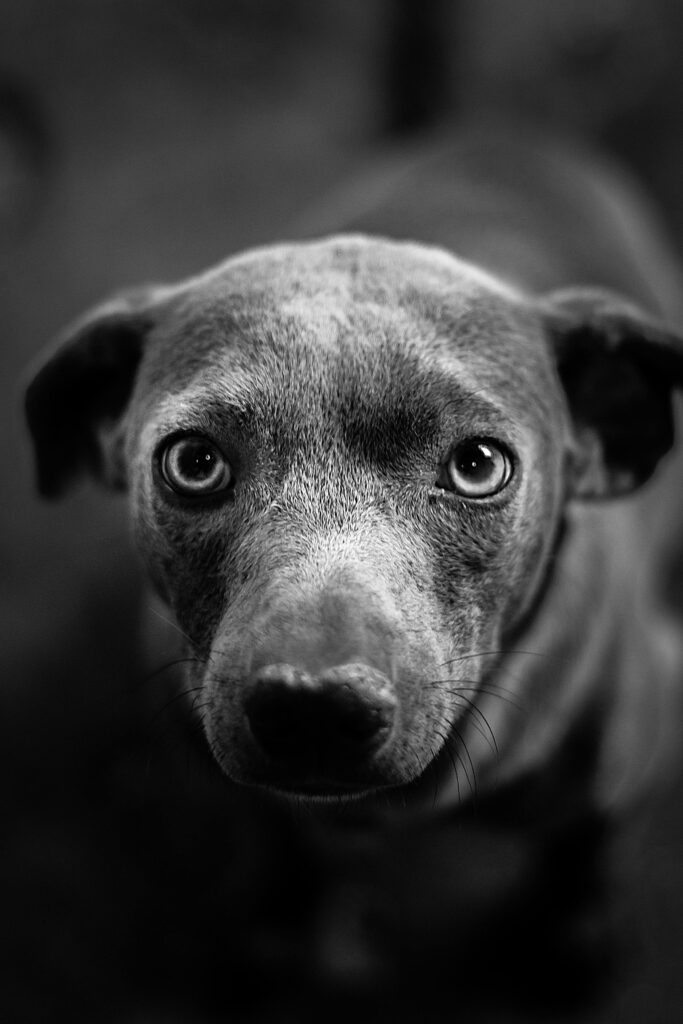
Catchlights are the tiny reflections of light in your dog's eyes. They are what make a portrait feel alive instead of empty. On a black dog they matter even more, because without them the eyes vanish into the dark face entirely.
To get catchlights, make sure there is a light source in front of your dog - a window, the open sky, a doorway - reflecting into the eyes. Position your dog facing toward that light, not away from it. Then watch the eyes: when you can see two little sparks, you are ready.
Step 5: Win the Timing Battle
Here is where most black-dog shots fall apart even when the light is perfect. You get everything dialed in, your dog is in the soft side light with catchlights in both eyes - and then it looks away the instant you go to shoot.
Dark coats give you almost no margin for a blurry or half-turned frame, because there is so little detail to begin with. You need the head up, the eyes toward the light, and the shutter all happening in the same second.
That is exactly the moment a reliable attention cue earns its keep. Squeak N Snap is a camera accessory that lets you trigger a clean, distinct sound right as you shoot, so your dog's eyes snap toward the lens at the exact instant you capture the frame. With a black dog, that one second of locked-in, eyes-forward attention is often the entire difference between a keeper and a delete.
Eyes forward. Shutter down. Same second.
Where black-dog photos are wonQuick Reference Checklist
Before you press the shutter on a black dog, run through this:
Before you shoot
- Soft, directional light - window or open shade, coming from the side
- Background a few shades lighter than the dog
- Exposure tapped and nudged up on the coat, not the scene
- Catchlights visible in both eyes
- An attention cue ready for the exact moment of the shot
The Takeaway
Black dogs are hard to photograph because their coats absorb light and confuse the camera - not because they are uncooperative. Light them softly from the side, set them against a lighter background, expose for the coat, protect the catchlights, and time the shot for the moment their eyes are forward. Do that, and your dark-coated dog finally looks like the photogenic companion you already know they are.
Want to nail the timing every time?
See how Squeak N Snap works