
Why Won’t My Cat Look at the Camera?
Cats ignore the camera because a phone lens is small, dark, and completely still, and cat eyes are built to track movement, not stare at static objects. What gets a cat’s eyes to the lens is a quick, unfamiliar movement right beside it, timed with the shutter – and a cue that gets overused stops working. Get the shot ready first, then one movement at the lens, one squeeze, one photo. Repeating the same cue over and over teaches your cat to tune it out.
The first cat we ever tested a prototype on was a big orange tabby who had zero interest in any of us. He had a favorite chair by a window, and he sat in that chair like he was posing for a portrait – right up until anyone raised a phone. Then he did the thing every cat owner knows: a slow blink, a slower turn of the head, and now you have a very nice photo of his ear.
If you have hundreds of these in your camera roll, you are not doing anything wrong. Cats are not being stubborn about the camera. They just have a completely different relationship with it than dogs do, and once you understand it, getting a real, eyes-to-the-lens cat photo gets a lot less mysterious.
Cats see movement, not lenses
A dog will often look at your phone because it looks at you, and your face is right behind the phone. A cat’s eyes work differently. Their vision is tuned for motion and contrast, especially in lower light. A phone lens is a small, dark, motionless circle. There is nothing about it that a cat is wired to care about.
On top of that, a phone held close to your face sits at a distance where cats do not focus especially well. So the lens is small, still, and slightly blurry. From your cat’s point of view, the most interesting thing in the room is literally anything else.
That is the whole reason folk tricks exist. Every cat photo tip you have ever heard – a crinkled bag, a feather held above the phone – works the same way. It puts a sudden sound or a moving thing right next to the lens so the cat’s eyes go there. The tricks are not the problem. The timing usually is.
Why the tricks stop working (and what keeps a cue alive)
Cats habituate fast. Faster than dogs, in my experience. A new sound gets one clean, curious look. The second time, you get a glance. The third time, your cat has decided the sound means nothing and goes back to whatever it was doing.
This is exactly where most people lose the shot. They find a noise that works, get excited, and repeat it six times in a row while fumbling with the phone. By the time the photo is framed, the cue is dead and the cat is bored.
Notice what actually killed it, though. It was not the noise. It was overuse. A cue your cat hears all day becomes furniture; a cue that only shows up at photo time stays interesting – which is why the dog squeaker still gets the same head-tilt after years of use. Cats are quicker to tune things out than dogs, but the rule is the same: keep the cue rare and it keeps working.
The other half is that a good photo does not need your cat’s attention. It needs one look for one instant, and the shutter has to fire in that instant. Hold the cat’s interest and you have a staring contest; catch one look and you have the photo. That reframes the whole thing from “how do I keep my cat interested” to “how do I time it.”
What to do (and what to stop doing)
- Wait until your cat is settled – after a meal, mid-nap, in a favorite spot.
- Get down to eye level and frame the shot with your cat doing nothing.
- Put the cue right beside the lens so the eyes land on the camera.
- Cue once, shoot once. One movement, one look, one photo.
- Use soft window light and turn the flash off.
- Give it a rest between attempts so the cue stays interesting.
- Chase your cat around the house with a phone up.
- Repeat the same sound five times while you get ready.
- Wave a toy or wand off to the side – the eyes go wherever it is, so it has to be at the lens.
- Use flash – you get glowing eyes and a cat that leaves.
- Fire off a whole run of frames and hope one lands.
- Say your cat’s name in a high voice over and over. That one dies fastest.
The two-hand problem
Here is the part nobody mentions. Even when you find a cue that works, you have one hand holding the wand or the bag and one hand holding the phone. The cue fires, the eyes come up, and then your thumb has to find the shutter. That gap is a fraction of a second – and a cat’s look is shorter than that. So the frame you actually get is the cat mid-turn, already losing interest.
Ask someone else to make the noise and it gets worse, not better. Now the cat is looking at them, and the moving thing is nowhere near your lens. You get a beautiful shot of your cat staring just past the camera.
The movement has to be at the lens, and the shutter has to fire in the same instant. That is a timing problem, not a trick problem, and it is the whole reason we started building for cats.
Why we are building a cat version of Squeak N Snap
Squeak N Snap started as a dog camera accessory. The person taking the photo holds a small plush squeaker; one squeeze fires the squeak and the phone’s Bluetooth shutter at the same instant, so the dog’s look and the picture happen together. That is what solves the 47-Photo Problem for dogs – one cue, one look, one keeper.
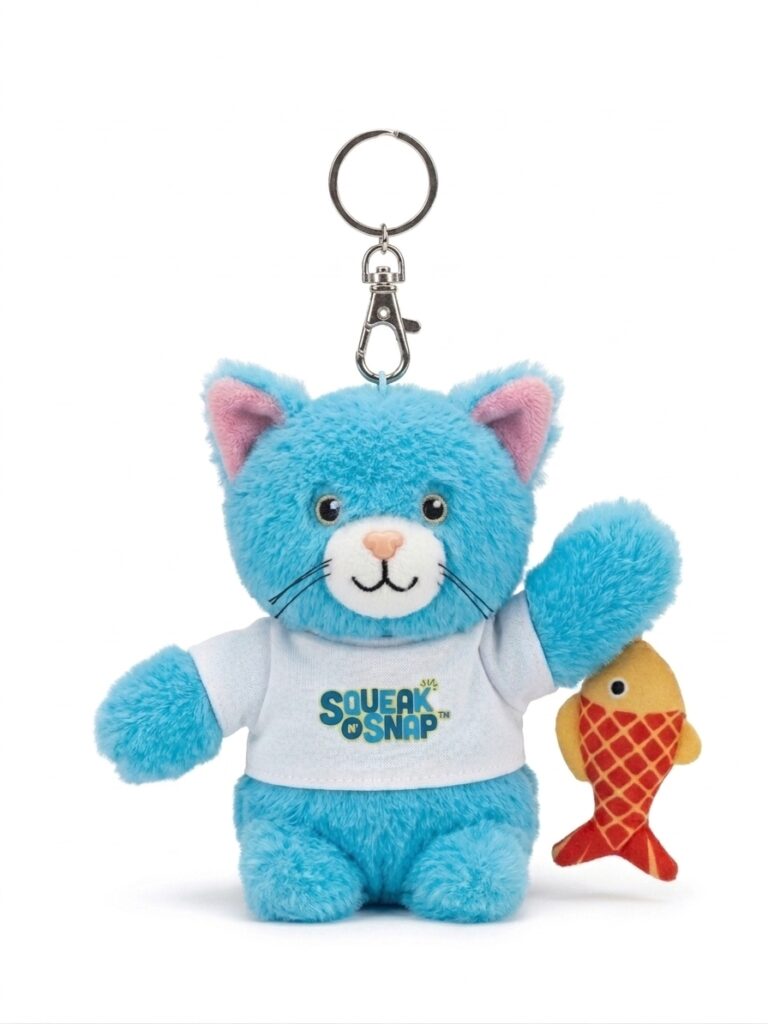
Cats need a different cue. Sound helps, but movement is what really grabs a cat, and it has to be right by the lens. So the cat version we are working on is a plush cat holding a fish on a string. The fish dangles and swings, and that swing is the attention grabber. The shutter still fires on the same squeeze, so the moment the eyes come up is the moment the photo is taken. Same idea, rebuilt for the animal that ignores your phone the hardest.
If you want to be first to see it, the signup lives on our cat page. Details below.
Frequently asked questions
Why does my cat look away every time I take a photo?
Because a phone lens is small, dark, and still, and cat vision is built for movement and contrast. Your cat is not avoiding the camera on purpose – there is simply nothing about a still lens that its eyes are drawn to.
How do I get my cat to look at the camera?
Set up the shot first, then put a quick movement right beside the lens and take the photo the instant the eyes come up – one cue, one shot. Repeating the cue teaches your cat to ignore it. The hard part is doing the movement and the shutter at the same time with two hands, which is the exact problem Squeak N Snap is built to solve.
Why do cat photo tricks stop working?
Overuse. Cats habituate quickly, so a sound or movement repeated all day becomes background noise. A cue that only appears at photo time stays interesting for years – the same reason a dog squeaker keeps working. Save the cue for the exact moment you shoot, and give it a rest between attempts.
Does Squeak N Snap work on cats?
The dog version relies on a squeak, and some cats do respond to it, but movement is what most cats react to. That is why a cat version is being built around a plush cat holding a fish on a string that swings near the lens, with the shutter fired on the same squeeze.
Be first to meet the cat version
Get an early look at Squeak N Snap for cats, plus the cat photo tips that actually work.
Mom-in-Chief at Squeak N Snap. Her photography experience comes from demos, rescue events, product testing, and three kids who never sit still.