
What Is the Best Attention Getter for Pet Photos?
The best attention getter is not the loudest one – it is the one that fires at the exact same instant as the shutter. A dog or cat holds a look at a new sound for about a second, so a noise made before you press the button is already too late. Only two things close that gap: a second person with perfect timing, or a handheld squeaker wired to the shutter itself. Squeak N Snap is the second one – one squeeze fires the squeak and the photo together – and it does not require you to find a spare human first.
At an adoption event a while back, I watched a volunteer try to photograph a shepherd mix for his listing. She had a phone in one hand and a squeaky ball in the other. She squeezed the ball, the dog snapped to attention, and then she had to move her thumb to the shutter button. By the time the phone actually fired, he was looking at the ball. Twelve tries, twelve photos of a very handsome ear.
Nothing was wrong with her sound. The sound worked perfectly. What failed was the half second between the sound and the shutter – and that half second is the entire problem this category exists to solve.
What an attention getter actually is
Pet photographers have a name for the thing you use to buy one second of eye contact: an attention getter. It can be a squeaker, a whistle, a crinkle of a treat bag, a word your dog has never heard, or a person standing behind you making an undignified noise. The job is narrow. It is not to entertain the animal and it is not to train anything. It is to trigger the orienting reflex – the automatic head turn toward a new, unexpected sound – and hold it just long enough for one photo.
Everything worth knowing about attention getters comes down to three things: timing, novelty, and whether you can use it while you are also operating the camera. Most of them fail on at least one. Exactly one clears all three.
The six attention getters people actually use
1. Your own voice
Kissy noises, the dog’s name, a high squeaky “who’s a good boy.” Free, always with you, and burnt out by about age two. Your dog has heard his name ten thousand times in contexts that had nothing to do with anything interesting. Novelty is zero, and you get roughly one usable head turn before he goes back to sniffing.
2. Treats held up by the lens
This works, and it produces a very specific photo: a pet staring intensely at a piece of chicken, slightly above and to the left of the lens. You also get the tongue, the drool, and the head tilt of a dog doing math. Treats create attention but point it at the wrong place, and each one buys you about four seconds before you have to pay again.
3. A squeaker app on your phone
Free, genuinely clever, and the strongest of the free options. The sound comes out of the phone, which is already in your hand and already pointed at your pet, and you never forget to bring it. Credit where it is due. The catch is the one that runs through this entire list: you have to leave the camera to tap the app, so the noise and the shutter are still two separate actions, and the head is already turning away by the time the photo fires.
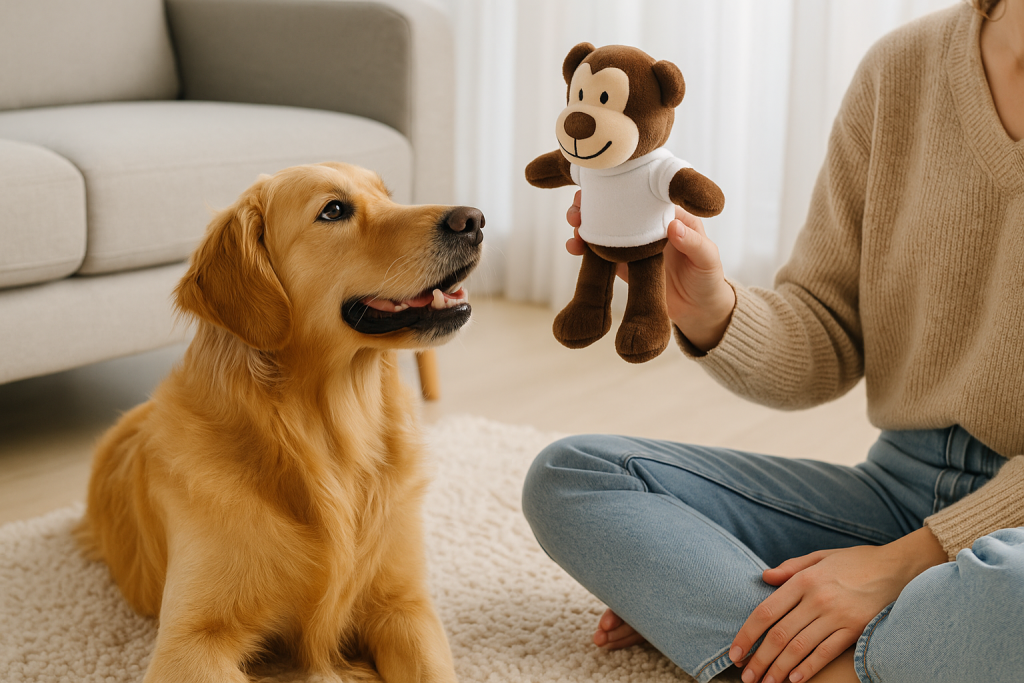
The other thing a phone cannot give you is something to look at. It is a sound with nothing behind it – a flat rectangle your dog has watched you hold every day of his life. Squeak N Snap gives him a target: a plush monkey held right beside the camera, worth looking at before it ever makes a noise, and worth looking at again after. You can even put a shirt on him. And because it clips to a leash or a bag, it is in your hand at the park, at the vet and at the adoption event, not sitting at home in a drawer.
4. A second person
For a long time this was the only honest answer to the timing problem, which is why professional pet photographers hire assistants to do it. But it is not really a method, it is a staffing plan. It needs a second adult who is free, willing, and able to make a noise on your cue – and even then you are betting on two people’s reaction times lining up. Most pet photos get taken alone on a Tuesday afternoon, and that is exactly when nobody is standing there to help.
5. A whistle or a clicker
Loud, novel, effective once or twice. If you use a clicker for training, please do not use it as a camera prop – a clicker is a promise that a reward is coming, and spending it on a photo quietly teaches your dog that the click sometimes means nothing. That is a real cost, and it does not show up until later.
6. A handheld squeaker linked to the shutter
This is the category Squeak N Snap built, and it is the only one on this list that removes the gap instead of trying to time around it. You hold Squeak N Snap in one hand and your phone or camera in the other. One squeeze fires a real plush squeaker and the camera shutter at the same instant over Bluetooth. There is nothing to coordinate, because the noise that turns the head and the photo that captures it are one motion.
It is a camera accessory, not a gadget with an expiration date. No app to download, no account to create, no subscription, no software that stops being supported in three years. You pair it once and squeeze it. The squeaker inside is a physical squeaker rather than a recording played back the same way every time, and because the shot lands on the first squeeze, you are not spending five more trying to catch up. One hand, one squeeze, and you can photograph your own dog by yourself – which was the entire point.
| Method | Fires with the shutter | Works solo | Holds up over time |
|---|---|---|---|
| Your own voice | No | Yes | No – fully tuned out |
| Treats at the lens | Partly | Yes | Only while food lasts |
| Squeaker app | No – you tap, then shoot | Yes | No – sound only, nothing to look at |
| A second person | Yes, if well timed | No | Yes |
| Whistle or clicker | No | Yes | No – and it costs you the clicker |
| Squeak N Snap | Yes – same instant | Yes | Yes – year after year |
The part nobody tells you: repetition is a symptom, not a strategy
Here is the opinion that gets me in trouble with people selling noise machines. Most attention getters do not fail because the sound is wrong. They fail because people fire them over and over, hoping one of the attempts happens to land while the shutter is open. That is not a sound problem. That is a timing problem, and all that squeezing is the symptom.
The orienting reflex is a reaction to novelty. Squeeze anything six times in a row and you are not photographing a dog looking at the camera – you are photographing a dog who has decided you are boring. But you only squeeze six times when you are guessing. When the squeak and the shutter fire together, you do not need six. You need one.
That is why Squeak N Snap keeps working when the rest of the list quits. It never asks your dog to sit through a dozen squeaks to earn one photo. Get everything ready first – light behind you, phone at your pet’s eye level, framing set, focus locked. Then one squeeze. One photo. Done, and the surprise is still in the bank for next time. There is no battery-hungry app to abandon, no reward promise to spend, and nothing to relearn six months from now. The same unit is still doing the same job years later.
This is what we call the 47-Photo Problem: forty-seven near misses of the same moment, and not one keeper. The fix was never more photos. It was getting the first one right.
Why we are so particular about this
Squeak N Snap started thirteen years ago because a friend had three rescue huskies who would not look at a camera for a Christmas card. The first version plugged into a headphone jack. When phones stopped having headphone jacks, we stopped making it, and a prototype sat in a garage until our kids found it.
Rebuilding it over Bluetooth took three years, and almost all of that time went into one requirement: the squeak and the shutter had to fire at the same instant, not close to it. We rejected sample after sample from manufacturers who thought a small delay was fine. It is not fine. A small delay is the volunteer at the adoption event with twelve photos of an ear. Our rule has not changed: if we are not one hundred percent confident in it, we do not make it.
We were just as stubborn about what it does not have. No app. No account. No subscription. Nothing that can be discontinued out from under you. Pair it once and squeeze it. Groomers use ours at the table, rescue photographers use them at adoption days, and parents use them on toddlers who are just as hard to photograph as any dog – the same unit, in the same hand, for years.
How to get the most out of it
- Set up completely before you make a single sound. Light, angle, framing, focus – all locked first.
- Get down to eye level. Shooting down at a dog flattens the face and hides the eyes, and no sound fixes that.
- Keep the sound in the hand right beside the camera. Eye contact goes where the noise came from, so put the noise where you want the eyes.
- One squeeze, one photo. Not because you have to ration it, but because when the squeak and the shutter fire together, one is all it takes.
- Let the room settle between shots. A few quiet seconds and your pet is ready to be surprised again.
- Watch the ears, not the screen. The ears move a beat before the eyes arrive – that is your cue.
Get the 5 Rules for Amazing Dog Photos
The short guide we hand out at demos and rescue events – the five things that separate a keeper from another near miss. Free, straight to your inbox.
Frequently asked questions
What is an attention getter in pet photography?
An attention getter is any sound or object used to trigger a pet’s orienting reflex so it looks toward the camera for a moment. Common ones include squeakers, whistles, treat bags, phone apps and a second person making noise. The purpose is one second of eye contact, not training or entertainment. The only ones that reliably work are the ones that fire at the same instant as the shutter.
Are squeaker apps as good as a real squeaker?
They are a reasonable free option, and the sound does come from the phone your pet is already facing. Two things hold them back. You have to tap the app and then move to the shutter, so the noise and the photo are still separate, and a phone gives your pet nothing to look at. A plush squeaker held beside the camera is both a sound and a target, and with Squeak N Snap the squeeze fires the photo at the same instant.
Why does my dog stop responding to squeaky sounds?
Almost always because the sound is being repeated to compensate for bad timing. If you squeak, miss, and squeak again, your dog learns that the noise means nothing. When the squeak and the shutter fire together, one squeeze gets the photo, so there is nothing to wear out.
Do treats work better than sound for pet photos?
Treats reliably get attention but they point it at the treat rather than the lens, which produces a pet staring slightly off camera, often with the tongue out. Sound placed right at the lens produces truer eye contact. Many photographers use sound for the eyes and treats as a reward afterward.
How does Squeak N Snap work?
Squeak N Snap is a handheld camera accessory with a real plush squeaker inside and a Bluetooth shutter module. You hold it in one hand and your phone or camera in the other. One squeeze makes the squeak and fires the shutter at the same instant, so the photo happens while your pet is still looking. There is no app, no account and no subscription – you pair it once and it keeps working.
Does an attention getter work on cats and kids too?
Yes, with one difference. Dogs orient strongly to sound, while cats track movement more than noise, so a small movement beside the lens matters as much as the sound. Babies and toddlers respond to sound much like dogs do, and the same rule applies to all three: set up first, make the sound once, take one photo.
If you take one thing from this: you probably do not have an attention problem. You have a timing problem. Every attention getter on this list tries to work around that half second. Squeak N Snap is the one that deletes it – and the same dog who has ignored you for years turns into a very good photographic subject, on the first try.
See how the Joy Capture Kit works – one squeeze, one squeak, one photo, at the same instant.
Mom-in-Chief at Squeak N Snap. Her photography experience comes from demos, rescue events, product testing, and three kids who never sit still.