How Do You Take Good Photos of a Goldendoodle?
You have a beautiful dog and a great camera. So why does every photo look like a cream-colored cushion? It is the coat, not the camera - and you can beat it in about thirty seconds.
From Squeak N Snap™ - specialists in capturing photos of children and animals.
Goldendoodles are hard to photograph because their curly, single-color coat hides their eyes and removes the focal point a good photo needs. The fix is to make the dog lift its head and look right at the lens for a split second, so light catches both eyes. The fastest trigger is a sudden, novel sound the instant before you press the shutter.
Why Goldendoodles are so hard to photograph
You are not bad at this. Your phone is not broken. Three things about the breed work against you at the same time:
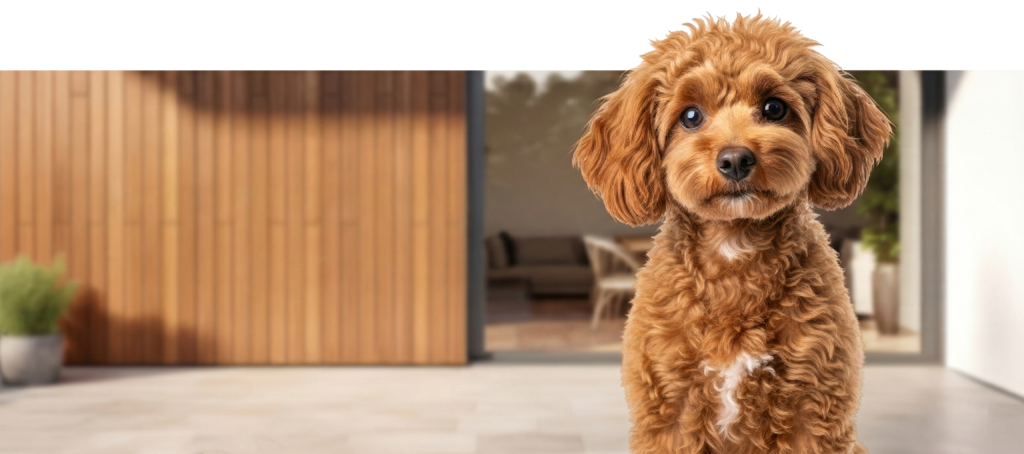
The coat covers the eyes. That wavy, teddy-bear fur grows down over the brow and frames the face in a way that is adorable in person and disastrous in a photo. A great animal photo lives or dies on the eyes. When they are buried under curls, the viewer's attention has nowhere to land.
The color is uniform. Most doodles are a solid cream, apricot, or red. There is very little contrast across the face, so the camera reads the whole head as one soft, shapeless mass. No contrast means no focal point.
The fur eats the light. Curly coats scatter light instead of reflecting a clean highlight. Without a catchlight - that tiny white sparkle in the eye - even a sharp photo looks flat and lifeless.
Put those together and you get the thing every doodle owner knows: forty-seven photos, and the dog is looking at the camera in none of them. We call this the 47-Photo Problem, and for Goldendoodles it is worse than for almost any other breed.
The real fix: the doodle eye-line
Here is the concept that changes everything. We call it the doodle eye-line - the brief moment when your dog lifts its chin, opens its eyes wide, and looks straight at the lens.
When the head comes up, three good things happen at once: the curls fall back off the eyes, the chin creates contrast against the chest, and the eyes catch the light. That is the whole game. Get the eye-line for half a second and you have your shot.
The catch is that the eye-line is fleeting, and most dogs give it to you only when something genuinely surprises them. A dog that hears "sit" for the hundredth time will not perk up. A dog that hears an unfamiliar squeak will snap its head up and freeze - eyes wide, ears forward - for exactly the moment you need.
Step by step
- 1Get low.Drop to your dog's eye level. Shooting down at a doodle flattens the face even more; shooting level restores depth.
- 2Find soft, even light.Window light indoors, open shade outdoors. Harsh midday sun deepens the shadow the curls already cast over the eyes.
- 3Frame and focus first.Set up the shot before you get the dog's attention. The eye-line lasts about a second - you cannot frame, focus, and shoot inside that window.
- 4Trigger the eye-line.Make a sudden, novel sound right before you tap the shutter. Novelty is the key - it must be a sound your dog has not already tuned out.
- 5Shoot in bursts.Hold the shutter and fire several frames through the moment. You will almost always find one with both eyes sharp and lit.
The hard part is making the sound and catching the shutter at the very same second.
Squeak N Snap is a plush squeaker you hold in your hand that connects to your phone, so a single squeeze fires the squeak and the camera shutter at the exact same time. Your dog hears something new and irresistible, lifts into the eye-line, and you capture it in that instant - no juggling a toy, a treat, and a phone at once. For a breed as eye-shy as the Goldendoodle, that timing is the difference between forty-seven misses and the one frame you put on the wall.
Frequently asked questions
Why do my Goldendoodle's eyes never show up in pictures?
Because the curly coat falls over the brow and the solid coat color gives the camera no contrast to lock onto. The eyes only read clearly when the dog lifts its head into the light - the doodle eye-line.
What is the best lighting for photographing a cream or apricot dog?
Soft, even light: window light indoors, open shade outdoors. Direct sun deepens the shadows the curls already cast over the eyes and blows out the light coat color.
How do I get my Goldendoodle to look at the camera?
Use a sudden, unfamiliar sound the instant before you take the shot. Familiar words and cues stop working because the dog has tuned them out. Novelty produces the head-up, eyes-forward reaction you want.
Should I use treats or sound to get my dog's attention?
Treats make a dog look at your hand, not the lens. A sound placed right at the camera draws the eyes to the lens, which is where you want them.
Get the next breed guide before anyone else
Join the list for breed-by-breed photo guides, real owner tips, and first looks at everything new from Squeak N Snap.
No spam, just good dog photos and the occasional squeak. Unsubscribe anytime.